









Stick Run is an endless runner where a stick figure sprints forward automatically and you survive by jumping over hazards and rolling under them.
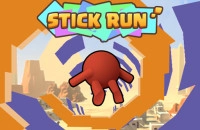
Here's a quick look at the game:
What is Stick Run?
Stick Run is a browser-based running game built around speed and reflexes. Your character keeps moving on its own through a tunnel-like course, and obstacles appear ahead without much warning. You do not steer the run in a broad sense. Instead, you react to each threat with the right movement at the right time.
The challenge comes from the run never really slowing down for you. Crates, barriers, and other hazards force quick choices between going over or going under. The longer you stay alive, the faster and more crowded the path feels, so the game turns into a constant timing test where one bad read can end the run instantly.
How to Play Stick Run
As soon as the run begins, the stick figure moves forward automatically. Your job is to read the obstacle type and respond before it reaches you. Ground obstacles usually call for a jump. Low overhead barriers usually call for a roll. The basic loop is simple: spot the danger, choose the correct action, survive the next few seconds, and keep building score.
The main goal is distance. There is no finish line to reach and no stage to clear in the usual sense. You keep going until you hit something. Because of that, every run becomes a score chase. Small errors matter more over time, especially when obstacles start appearing in tighter combinations that force fast transitions from jump to roll and back again.
Good play depends on staying ahead of the screen. You should keep your eyes slightly in front of the character so you can identify the next obstacle early. Waiting until the last second can work at low speed, but longer runs punish late reactions. The game becomes more demanding as your pace rises, so smooth timing is more important than panicked inputs.
Controls
| Key | Action |
|---|---|
| Up Arrow | Jump |
| Down Arrow | Roll |
Tips of Stick Run
- Look at the incoming lane ahead of the runner instead of staring at the character’s feet.
- Use early, controlled inputs. Late jumps and rushed rolls are the easiest way to clip an obstacle.
- Learn the obstacle height quickly so you do not waste jumps on barriers that should be rolled under.
- Treat long runs as rhythm play: once the speed rises, steady timing is safer than sudden corrections.