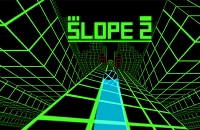









Play Slope 2, a 3D endless runner where you steer a rolling ball down a neon track, dodge red obstacles, clear gaps, and chase a high score.

Here's a quick look at the game:
What Is Slope 2?
Slope 2 is a 3D endless rolling game where you guide a ball down a narrow track suspended in a neon environment. The ball moves forward automatically, so your job is to steer left and right, stay on the course, and avoid anything that can instantly end your run.
There is no finish line to reach. Instead, you try to survive for as long as possible and increase your score by traveling farther down the slope. The challenge becomes harder as the ball accelerates and the track introduces tighter turns, gaps, narrow sections, ramps, and red obstacles.
Slope 2 keeps its controls minimal. You cannot jump over danger or use a brake to stop before a difficult section. Every problem has to be handled by choosing the correct line and making your steering adjustments early enough.
How to Play Slope 2
The ball begins rolling forward as soon as the run starts. Use the left and right controls to keep it centered on the track and guide it around hazards.
Your run ends if the ball falls from the edge or collides with a dangerous red obstacle. Because your speed increases as you continue, sections that look easy at the beginning become much more difficult when you reach them at higher speed.
Try to look farther down the track instead of focusing entirely on the ball. Seeing a gap or obstacle early gives you more time to move into a safe position without making a sudden turn at the last second.
Controls
| Action | Control |
|---|---|
| Steer left | A or Left Arrow |
| Steer right | D or Right Arrow |
There is no jump button and no brake during the main run. The ball keeps moving forward automatically, making steering accuracy the central mechanic.
Avoid Red Obstacles and Track Gaps
Red objects are some of the most important hazards to watch for in Slope 2. Hitting one ends the run, so begin moving around it before the ball gets too close.
Gaps are equally dangerous. Some sections of the course separate into smaller platforms or leave open spaces that you need to pass by choosing the correct part of the track. If you steer too aggressively near an edge, the ball can slide away from the safe surface even when there is no obstacle directly in front of you.
Ramps and drops can also send the ball into the air. When approaching them, try to enter from a stable position. Landing near the middle of the next platform gives you more room to react to whatever appears afterward.
Speed Keeps Increasing
One of the main difficulties in Slope 2 is that the pace does not remain constant. The farther you travel, the faster the ball moves and the less time you have to react.
At lower speeds, you can correct a poor position with a longer steering input. At higher speeds, the same movement may send the ball straight over the opposite edge. This is why small steering taps become increasingly useful during a strong run.
The increasing speed also changes how you should read the track. Instead of waiting until an obstacle is directly in front of you, look ahead and decide which side you want to approach from before reaching it.
How Scoring Works
Slope 2 is built around an endless high-score loop. Your score improves as you continue traveling without crashing or falling from the course.
There is no need to defeat enemies or complete a fixed set of stages. A successful run is simply one that lasts longer than your previous attempts. This makes consistency more valuable than risky steering.
If you are trying to improve your best score, concentrate on surviving difficult sections rather than making unnecessary movements near the edges. Every extra section you clear gives you another opportunity to extend the run.
Steering Tips for Longer Runs
- Use short inputs at high speed. Holding left or right for too long can easily cause an overcorrection.
- Stay near the center when possible. A central position gives you space to react in either direction.
- Look ahead of the ball. Watch upcoming gaps, turns, and red obstacles instead of staring only at your current position.
- Set up before ramps. Enter jumps from a stable line so you have a better chance of landing safely.
- Avoid last-second turns. Early, gentle corrections are usually safer than one large movement near an obstacle.
- Do not overcorrect after landing. Give the ball a moment to settle before making another large directional change.
Learn to Control Momentum
Although Slope 2 only asks you to steer in two directions, the ball's speed and momentum make those controls increasingly sensitive. A movement that is safe near the beginning of a run may be far too strong after the pace increases.
Try tapping the steering keys instead of holding them continuously. Small corrections help you follow narrow paths while keeping enough space to adjust when the track suddenly changes direction.
When you make a mistake but remain on the track, avoid immediately steering hard in the opposite direction. Overcorrecting can turn a recoverable position into a fall. Bring the ball back toward the center gradually whenever the available space allows it.
Chase a Higher Score in Slope 2
Slope 2 is ultimately a test of reaction time, anticipation, and precise steering. You only need two movement directions, but increasing speed means every decision has to become faster and more controlled as the run continues.
Keep the ball away from red obstacles, line up carefully for gaps and ramps, and make smaller movements as your speed rises. The course does not give you a jump or brake to escape a mistake, so reading the path early is the best way to stay alive and push your score farther.