






Geometry Lite is a rhythm platformer with 15 stages where you time jumps, dodge deadly obstacles, and master changing movement sections.
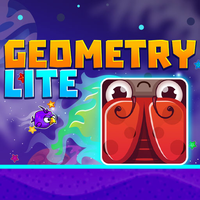
Here's a quick look at the game:
Geometry Lite is a browser rhythm platformer developed by Greenlight in which your character moves forward automatically while you control the actions needed to survive each stage. The goal is to reach the end of the course without hitting spikes, blocks, triangles, or other hazards. Its 15 stages include names such as Stereo Madness, Back on Track, Polargeist, Dry Out, and Electrodynamix.
Reaching the End of Each Stage
Most sections put you in control of a square character that keeps moving without directional steering. Your main decision is when to jump. A mistimed input can send the character directly into a spike or another obstacle, and a failure in Normal mode returns the run to the beginning.
The levels also change how movement works. Some sections focus on jumping over ground hazards, while others switch to a flying character that must stay between the upper and lower edges of a tunnel. These changes make recognizing the current movement type as important as memorizing the obstacle layout.
Geometry Lite includes both Normal mode and Practice mode for its maps. Practice mode is useful for learning sections that repeatedly stop a full run before attempting them from the start in Normal mode.
Controls
Use a mouse click, Spacebar, or the Up Arrow key to control the character. During standard running sections, the input makes the character jump. The same simple input system is used when the game changes into other movement phases, although the resulting movement can differ.
Because forward movement is automatic, avoid clicking too early simply because an obstacle is visible. The character continues advancing while airborne, so the distance between hazards determines when the jump should begin.
Improving Your Runs
Repeated failures reveal the obstacle sequence ahead. Since a collision can restart a Normal-mode attempt, remember where closely spaced spikes, blocks, and movement changes appear instead of reacting to each hazard as if it were new.
Use Practice mode when one section repeatedly ends your run. Learning that specific sequence reduces the number of mistakes you need to solve during a complete attempt. When a stage switches from jumping to flying, adjust immediately to the new movement behavior rather than continuing with the timing pattern used for the previous section.